


The sacred holy relic of York
- farfromtheordinary
- Oct 1, 2025
- 3 min read
Updated: Nov 4, 2025
The historic city of York attracts 8.9 million tourists a year. Visitors get the chance to queue easily for six hours to purchase a ghost from the York Ghost merchants. Have the pleasure of fighting their way through the bustling crowds to shop at the never ending chain of trinket shops inspired by some teenage wizard. Most of the time there is even a queue of tourists having their picture taken with the street sign of Whipmawhopmagate, a street only longer than a few strides. Whether it be to lack of awareness or just because it’s just not for them, only a few thousand take the opportunity to see an actual Holy Relic.
Margaret Clitheroe, known as the “Pearl of York,” is one of the most revered English Catholic martyrs of the 16th century. Her legacy is marked not only by her unwavering faith but also by a fascinating relic: her mummified hand, which continues to inspire devotion and intrigue centuries after her death.


Her exact birthday is unknown but Margaret was born in 1556 and raised in York, England, unfortunately during a time of intense religious conflict in England following King Henry VIII’s break from the Catholic Church. Originally raised Protestant, Margaret converted to Catholicism after her marriage to John Clitheroe, a successful butcher and himself of Protestant faith. Despite the dangers imposed by England’s strict anti-Catholic laws under Queen Elizabeth I, Margaret remained a devout and active Catholic.
Her home on The Shambles, the famous historic street in York, became a refuge for Catholic priests who were persecuted and faced execution if discovered. Margaret helped organize regular secret Masses and provided shelter for clergy, knowing that the punishment for harboring priests was severe.
Margaret’s unwavering faith and frequent, albeit well advertised, clandestine assemblies eventually led to her arrest in 1586 when authorities raided her home and found evidence of Catholic materials and priests’ vestments. Refusing to plead guilty to the charges—partly to protect her family from being forced to testify against her—she was sentenced to a brutal execution known as “pressing” (peine forte et dure).

On March 25 1586, aged 30 years, Margaret was dragged from her home to endure an agonising and horrific death. She was laid flat on her back with a rock underneath her spine. A thick wooden plank similar in size to a door was placed on top of her. Everytime she was asked to confess her sin and give up the Catholic faith, Margaret refused. Her interrogators would then place a sturdy weight on the board. Even as more and more weight was piled on top, Magaret did not waiver and stayed true to her faith. Witnesses reported she would gasp for breath under the pressure of the load but still endeavoured to recite Catholic prayers and plead for the forgiveness of her persecutors.
It took until 1970 when Pope Paul VI officially recognised Margaret’s courage and unwavering commitment to the church, it was at this time she was canonized as a saint.
One of the most intriguing aspects of Margaret Clitheroe’s legacy is the existence of her mummified hand, which has become an important relic for Catholics. According to legend, her hand was removed following her execution and preserved as a relic of her holiness. Some believe that it was severed after her beatification, while others suggest it was taken clandestinely by supporters shortly after her death.
Even after more than four centuries, the hand remains remarkably well-preserved, a phenomenon often attributed to divine intervention. Today, the relic is housed in the Bar Convent Museum in York, where pilgrims and visitors can view it as a testament to Margaret’s martyrdom and devotion.

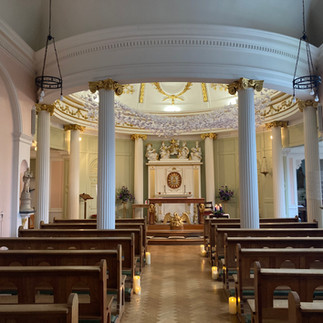


Relics play a crucial role in Catholic tradition, serving as tangible connections to the saints and inspiring devotion among the faithful. Margaret Clitheroe’s mummified hand is particularly symbolic, representing her work in protecting Catholic priests and supporting the underground church during one of England’s most dangerous religious persecutions.
For many, the relic serves as a powerful reminder of the sacrifices made by early English Catholics and the enduring strength of faith in the face of adversity. It continues to attract pilgrims from around the world who seek spiritual inspiration and a connection to England’s Catholic heritage.


The Bar Convent in York, England, is the current home of Margaret Clitheroe’s hand. The convent itself is steeped in history, being the oldest living convent in England, and offers exhibitions about Catholic history in England. There is even a priest hole on display that was used. Whether viewed as a Holy Relic or just as an item of curiosity a mummified hand is a rarity outside the large London museums.
The Bar Convent Heritage Centre
17 Blossom Street
York
YO24 1AQ


Comments