


Les Catacombs De Paris
- farfromtheordinary
- Sep 30, 2025
- 3 min read
Updated: Nov 14, 2025
When tourists think of Paris, they imagine glittering boulevards, romantic cafés, and the twinkle of the Eiffel Tower. Yet, beneath the city’s refined façade lies a subterranean labyrinth—an ossuary so vast and unsettling that it has earned its own place in history: the Paris Catacombs. With their dim corridors lined by millions of human remains, the Catacombs are as much a chilling museum of death as they are an engineering marvel.


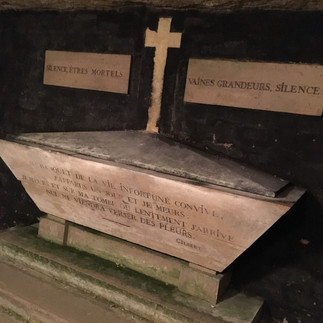


In the late 18th century, Paris faced a serious public health crisis. The city’s cemeteries—some dating back to the Middle Ages—were overflowing. Les Innocents Cemetery in particular had become notorious for its unsanitary conditions, with decaying bodies contaminating nearby wells and creating an unbearable stench. In 1786, city officials began transferring the remains from these overstuffed graveyards to a network of abandoned limestone quarries beneath the capital.
Workers spent years carefully moving bones and stacking them in decorative patterns—skulls and femurs forming eerie walls that stretch for miles underground. The official name for the site became “l’Ossuaire Municipal,” though the public soon took to calling them simply “Les Catacombes,” after the Roman catacombs.
Today, only about a mile of the estimated 200+ miles of tunnels are open to the public. Even in this small portion, the displays are strikingly theatrical. Bones are arranged in symmetrical patterns, stacked like bricks, or assembled into crosses, hearts, and other macabre shapes. Plaques bearing somber inscriptions remind visitors of their own mortality—“Arrête! C’est ici l’empire de la mort.” (“Stop! This is the empire of death.”)
Beyond the tourist section, countless more tunnels wind into darkness. Urban explorers—“cataphiles”—have been known to sneak into off-limits areas to map, photograph, or even throw secret underground parties. Stories abound of explorers getting lost, discovering hidden rooms, or finding old relics of revolutionary Paris.
Because the bones came from multiple cemeteries, some of France’s most notable historical figures are believed to lie within the Catacombs. Though their exact remains are unmarked, it’s widely believed that the philosopher Jean-Paul Marat, playwright Molière, and fabulist Jean de La Fontaine all have bones mixed among the millions. The Catacombs also received victims of the French Revolution, including those guillotined during the Reign of Terror.


The Catacombs have inspired countless myths and birth to as many ghost stories as skulls within the tunnels. Some visitors claim to hear whispering voices in the tunnels, or feel a sense of being watched. A famous urban legend tells of a video camera found deep underground with footage of a man becoming lost and panicked—his fate unknown.
During World War II, both the French Resistance and Nazi occupiers reportedly used the tunnels as hideouts and bases. Graffiti from the 1940s still lingers on some walls.


The entrance to the Catacombs is at 1 Avenue du Colonel Henri Rol-Tanguy in the 14th arrondissement, known as the gateway to hell. Tickets are required, and only a limited number of people are allowed underground at a time to preserve the site. The descent begins with a spiral staircase into a cool, dimly lit passage before entering the ossuary—a sobering reminder of the fragility of life beneath one of the world’s most vibrant cities.
Self exploring option is available but booking with a registered tour guide gets you special access to some sections not accessible to the public and well worth the upgrade.
1 av. du Colonel Henri Rol-Tanguy
75014
Paris


Comments